
SAP Accounting Software: The Ultimate Guide to SAP S/4HANA Finance & FICO
Table of Contents
- • What is SAP Accounting Software?
- • Core Sub-Modules of SAP Financial Accounting (FI)
- ↳ 1. General Ledger Accounting (FI-GL)
- ↳ 2. Accounts Payable (FI-AP)
- ↳ 3. Accounts Receivable (FI-AR)
- ↳ 4. Asset Accounting (FI-AA)
- ↳ 5. Bank Ledger & Treasury (FI-BL)
- • The Controlling (CO) Module: Internal Management Accounting
- ↳ Key Components of Controlling:
- • The Game Changer: SAP S/4HANA Universal Journal (ACDOCA)
- ↳ Why Table ACDOCA Transformed Financial Accounting:
- • Integration Points: How SAP Finance Connects Across the Enterprise
- ↳ 1. Materials Management (MM) to FI Integration
- ↳ 2. Sales and Distribution (SD) to FI Integration
- ↳ 3. Human Capital Management (HCM) / SuccessFactors Integration
- • Comprehensive Comparison: SAP ECC 6.0 FICO vs SAP S/4HANA Finance
- • Key Benefits of Implementing SAP Accounting Software
- ↳ 1. Global Multi-Currency and Multi-GAAP Compliance
- ↳ 2. Continuous Financial Closing
- ↳ 3. Advanced Fraud Prevention and Internal Controls
- ↳ 4. Complete Auditability & Transparency
- • Migration Roadmap: Moving from ECC to S/4HANA Finance
- • Career Scope & Opportunities for SAP Finance Specialists
- ↳ Common Career Roles:
- ↳ Key Certifications:
- • Frequently Asked Questions (FAQs)
- ↳ Q1: Is SAP accounting software suitable for small and medium businesses?
- ↳ Q2: What is the main difference between SAP FI and SAP CO?
- ↳ Q3: What is Table ACDOCA in SAP S/4HANA Finance?
- ↳ Q4: How long does an SAP Finance implementation typically take?
- ↳ Q5: Can SAP Accounting Software integrate with third-party banking and billing software?
- • Final Thoughts & Key Takeaways
- ↳ Summary of Key Takeaways:
 Figure 1: SAP S/4HANA Finance delivers real-time financial reporting, automated general ledger tracking, and instant executive analytics across global business units.
Imagine a global enterprise operating across 40 countries, managing 15 distinct local currencies, processing millions of customer invoices every quarter, and adhering to strict international financial compliance frameworks like IFRS and US GAAP.
In traditional financial setups using fragmented accounting systems, completing a single month-end financial close required up to 15 business days. Corporate accounting teams spent hundreds of hours extracting data into spreadsheets, running manual reconciliation scripts between general ledgers and sub-ledgers, and chasing down discrepancies across cost centers.
Enter SAP accounting software.
For over four decades, SAP has served as the undisputed technological foundation of global enterprise finance. Today, with SAP S/4HANA Finance powered by in-memory computing, the paradigm of financial management has shifted entirely. Month-end financial reconciliation is no longer a multi-week post-mortem operation—it has evolved into a continuous, real-time, zero-latency financial process.
Whether you are a Chief Financial Officer evaluating enterprise ERP solutions, an IT manager preparing for an S/4HANA migration, or an aspiring functional consultant looking to master SAP FICO fundamentals, this definitive guide covers everything you need to know about SAP accounting software.
Before diving deep into technical modules, feel free to browse our main learning hub, learn more about our team, check our FAQ page, or explore our quick T-Code Lookup Tool.
What is SAP Accounting Software?
At its core, SAP accounting software is the financial backbone of SAP’s Enterprise Resource Planning (ERP) platform. It is designed to capture, record, structure, and analyze every single monetary transaction across an organization in real time.
Unlike standalone bookkeeping software (such as QuickBooks or Xero) built primarily for small businesses, SAP accounting software is architected for complex multinational operations. It manages multi-company code structures, parallel financial ledgers, automated cross-border tax compliance, high-volume transactional sub-ledgers, and intricate managerial cost allocations.
System financial data in SAP is governed by two complementary management domains:
- Financial Accounting (FI): Designed for external financial reporting. FI records every transaction to produce legally mandated financial statements—including Balance Sheets, Income Statements (Profit & Loss), and Cash Flow Statements—for shareholders, tax authorities, auditors, and regulatory bodies.
- Controlling (CO): Designed for internal managerial accounting. CO provides internal executive leadership with granular visibility into cost centers, profit centers, product cost calculations, and market profitability segments to drive operational strategy.
According to global financial reporting guidelines established by IFRS Standards and standards published by the AICPA, digital financial architecture must guarantee complete audit traceability, immutable posting logs, and strict segregation of duties (SoD)—all core design pillars of SAP software.
Core Sub-Modules of SAP Financial Accounting (FI)
The Financial Accounting (FI) suite consists of several tightly integrated sub-modules. Each sub-module manages a specific domain of financial operations while automatically feeding transactional data into the central General Ledger.
                  +-----------------------------------+
                  |   SAP Financial Accounting (FI)   |
                  +-----------------------------------+
                                    |
     +-----------------+------------+------------+-----------------+
     |                 |                         |                 |
+----+----+      +-----+---+               +-----+---+       +-----+---+
|  FI-GL  |      |  FI-AP  |               |  FI-AR  |       |  FI-AA  |
| General |      | Accounts|               | Accounts|       | Asset   |
| Ledger  |      | Payable |               |Receivable|      |Account. |
+---------+      +---------+               +---------+       +---------+
1. General Ledger Accounting (FI-GL)
The General Ledger (GL) is the central master repository of an organization’s accounting data. Every credit and debit posted across any operational module eventually resolves into a General Ledger account.
- Chart of Accounts (CoA): Defines the structured list of all GL accounts used by one or more company codes.
- Parallel Ledgers: Enables businesses to maintain multiple accounting ledgers simultaneously (e.g., Leading Ledger for IFRS compliance alongside Non-Leading Ledgers for local statutory tax laws).
- Real-Time Balance Tracking: Eliminates batch posting delays so trial balances are accurate at any given second.
2. Accounts Payable (FI-AP)
The FI-AP sub-module records and manages all vendor-related financial transactions.
- Vendor Master Records: Stores vendor addresses, bank details, payment terms, and tax identification numbers.
- Automated Payment Program (F110): Executes mass electronic vendor payments via wire transfers, ACH, or checks based on due dates and cash discount terms.
- Three-Way Matching: Automatically validates purchase orders (MM), goods receipts (GR), and vendor invoices (IR) before releasing payments, preventing fraudulent or duplicate disbursements.
3. Accounts Receivable (FI-AR)
The FI-AR sub-module tracks all customer invoices, credit limits, and incoming cash collections.
- Customer Credit Management: Monitors credit limits and automatically blocks sales orders if a customer exceeds their approved credit threshold.
- Dunning Program (F150): Automatically generates reminder notices and collection letters for overdue customer invoices.
- Cash Application: Automatically matches incoming electronic bank payments against outstanding customer invoices.
4. Asset Accounting (FI-AA)
The FI-AA sub-module manages the complete lifecycle of fixed assets—from acquisition to retirement.
- Asset Lifecycle Management: Tracks equipment, real estate, vehicles, machinery, and intellectual property.
- Depreciation Calculations: Automatically calculates straight-line, declining balance, or custom depreciation values across multiple tax keys simultaneously.
- Capital Work in Progress (CWIP): Tracks construction-in-progress costs before transferring them into active capitalized assets upon project completion.
5. Bank Ledger & Treasury (FI-BL)
Manages bank account balances, incoming and outgoing cash flows, and electronic bank statement (EBS) processing. It integrates directly with corporate banking APIs to automate daily bank reconciliation.
For more technical breakdowns of transaction codes and system structures, explore our guide on SE11 Transaction Code in SAP ABAP and our tutorial on Table Maintenance Generators.
The Controlling (CO) Module: Internal Management Accounting
While FI satisfies external reporting mandates, the Controlling (CO) module equips management with internal decision-making insights. CO focuses on operational efficiency, cost distribution, and profitability.
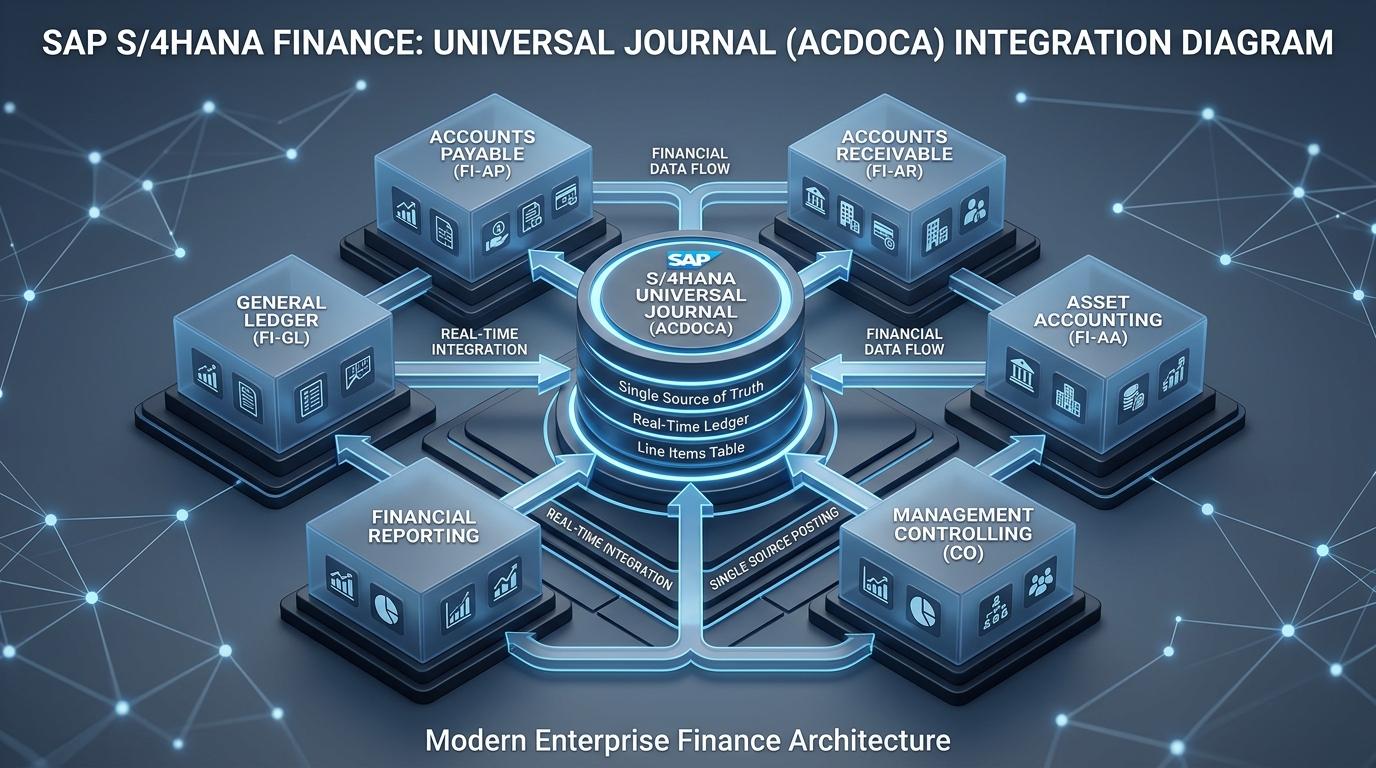 Figure 2: The SAP S/4HANA Universal Journal (ACDOCA) unifies Financial Accounting (FI) and Controlling (CO) into a single line-item source of truth.
Key Components of Controlling:
- Cost Center Accounting (CO-OM-CCA): Tracks overhead expenses by internal departments (e.g., IT, HR, R&D, Marketing) to evaluate operational efficiency.
- Internal Orders (CO-OM-OPA): Tracks temporary project expenses or specific events (e.g., trade show budget) separate from standard department cost centers.
- Product Cost Controlling (CO-PC): Calculates the exact cost of goods manufactured (COGM) and cost of goods sold (COGS) by rolling up raw material costs, labor hours, and machine overhead.
- Profitability Analysis (CO-PA): Analyzes margins by market segments, customer groups, sales regions, or product lines to guide strategic commercial decisions.
The Game Changer: SAP S/4HANA Universal Journal (ACDOCA)
In legacy SAP systems (such as SAP R/3 or ECC 6.0), Financial Accounting (FI) and Controlling (CO) operated as separate modules with distinct database tables.
GL line items lived in table BSEG, Accounts Payable in BSIK/BSAK, Accounts Receivable in BSID/BSAD, and Controlling line items in COEP. At the end of every month, financial teams had to execute complex batch reconciliation programs to ensure FI and CO balanced perfectly.
With SAP S/4HANA Finance, SAP introduced the revolutionary Universal Journal (Table ACDOCA).
===================================================================
                SAP S/4HANA UNIVERSAL JOURNAL (ACDOCA)
===================================================================
 [GL Account] | [Vendor/Customer] | [Asset ID] | [Cost Center] | [Profitability Segment]
-------------------------------------------------------------------
   100020     |   Vendor #8401    |  AS-9002   |   CC-1020     |   Region: APAC / Prod: A1
===================================================================
Why Table ACDOCA Transformed Financial Accounting:
- Single Source of Truth: Every financial transaction—whether an FI entry, a CO cost allocation, or an Asset depreciation posting—is stored in a single unified line-item table (
ACDOCA). - Zero Reconciliation Required: Because FI and CO share the exact same database table, reconciliation between external reporting and internal cost accounting is instantly eliminated.
- Massive Data Compression: In-memory column-store database technology eliminates traditional aggregate and index tables, reducing database storage requirements by up to 80%.
- Drill-Down Granularity: Financial managers can drill down instantly from a multi-million-dollar high-level Balance Sheet line item straight into the granular operational line items that created it.
To understand how modern cloud environments leverage this database architecture, read our technical walkthrough on SAP BTP ABAP Environment (Steampunk).
Integration Points: How SAP Finance Connects Across the Enterprise
One of the greatest competitive advantages of SAP accounting software is its seamless integration with non-financial business processes. Money flows automatically in the background whenever operational business events occur.
 Figure 3: Cross-departmental integration between SAP MM, SD, and Finance enables real-time tracking of operational margins and cash flow.
1. Materials Management (MM) to FI Integration
When a warehouse manager receives raw materials from a supplier:
- The warehouse performs a Goods Receipt (GR) in SAP MM.
- SAP automatically posts a financial entry crediting the GR/IR Clearing Account and debiting Inventory Account in FI-GL—without human intervention.
2. Sales and Distribution (SD) to FI Integration
When a sales department fulfills a customer order:
- The goods issue reduces physical inventory in SD.
- Generating the customer invoice automatically posts a debit to Accounts Receivable (FI-AR) and a credit to Sales Revenue (FI-GL).
3. Human Capital Management (HCM) / SuccessFactors Integration
Payroll runs automatically aggregate employee salaries, tax withholdings, and health insurance contributions, generating structured General Ledger entries mapped to department cost centers.
If you are interested in exploring how custom interfaces and integration flows are built, check out our guide on SAP BTP Integration Suite Explained and SAP ABAP BAPI Complete Guide.
Comprehensive Comparison: SAP ECC 6.0 FICO vs SAP S/4HANA Finance
The table below highlights the architectural and functional differences between legacy SAP ECC FICO and modern SAP S/4HANA Finance:
| Feature / Architecture Domain | Legacy SAP ECC 6.0 (FICO) | Modern SAP S/4HANA Finance | Strategic Business Impact |
|---|---|---|---|
| Database Architecture | Traditional relational DB (Oracle, DB2, SQL Server) | In-Memory SAP HANA Columnar DB | 100x to 1000x faster query execution speeds |
| Data Storage Engine | Multiple separate tables (BSEG, COEP, BSIS, COBK) | Single Unified Table ACDOCA (Universal Journal) | Single source of financial truth; no data redundancies |
| Reconciliation Effort | Heavy month-end batch reconciliation between FI & CO | Zero reconciliation needed (FI and CO integrated natively) | Speeds up month-end financial close by up to 70% |
| User Interface | Desktop SAP GUI with complex T-Codes | Modern, responsive SAP Fiori apps | Mobile access on tablets & smartphones; lower training cost |
| Financial Reporting | Batch background jobs & static reports | Real-time embedded analytics & drill-downs | Instant executive decision-making visibility |
| Credit Management | FI-AR Credit Management | FI-FSCM (Financial Supply Chain Management) | Automated real-time credit scoring & risk assessment |
| Asset Accounting | Classic Asset Accounting (separate posting runs) | New Asset Accounting (real-time parallel ledger posting) | Simultaneous real-time multi-GAAP asset valuation |
For a broader perspective on modernizing user interfaces across SAP enterprise systems, read our article on Why SAP Fiori Matters More Than You Think and explore SAP Fiori Elements Floorplans.
Key Benefits of Implementing SAP Accounting Software
Why do over 90% of Forbes Global 2000 companies rely on SAP accounting software to manage their corporate finances?
1. Global Multi-Currency and Multi-GAAP Compliance
Global corporations must report financial results according to local country regulations (e.g., statutory tax laws in Germany, India, or Japan) while simultaneously consolidating parent company financials under IFRS or US GAAP. SAP supports unlimited parallel currencies, automated foreign currency revaluation, and parallel accounting ledgers.
2. Continuous Financial Closing
Traditional accounting forces finance teams to wait until the end of the month to understand profitability. SAP S/4HANA Finance enables continuous closing—allowing CFOs to view soft balance sheets and income statements at any day of the month.
3. Advanced Fraud Prevention and Internal Controls
SAP enforces strict Segregation of Duties (SoD) controls. For example, the system prevents the same user who creates a vendor master record from approving invoices or releasing payments to that vendor, eliminating internal fraud vulnerabilities.
4. Complete Auditability & Transparency
Every financial document created in SAP receives a unique document number, timestamp, user ID stamp, and change history log. External auditors can trace any high-level financial summary straight down to the original purchase order or shipping document.
Migration Roadmap: Moving from ECC to S/4HANA Finance
Transitioning an enterprise from legacy SAP ECC 6.0 to SAP S/4HANA Finance requires strategic architectural planning. Organizations typically choose one of three deployment pathways:
                      +-----------------------------------+
                      |   S/4HANA Migration Pathways      |
                      +-----------------------------------+
                                        |
        +-------------------------------+-------------------------------+
        |                               |                               |
 +------v------+                 +------v------+                 +------v------+
 | Greenfield  |                 | Brownfield  |                 | Central Fin.|
 | Re-implement|                 | Conversion  |                 | Side-by-Side|
+-------------+ +-------------+ +-------------+- Greenfield (New Implementation): The organization re-architects its financial processes from scratch on S/4HANA Cloud, wiping away legacy technical debt and adopting standard SAP best practices.
- Brownfield (System Conversion): The existing SAP ECC system—including historical financial data, customized ABAP programs, and configurations—is converted directly into S/4HANA Finance.
- Central Finance (Hybrid Step-by-Step): A central SAP S/4HANA Finance system is deployed alongside existing legacy ERP systems. Transactions are replicated in real time to the Central Finance hub without disrupting underlying operational systems.
To ensure long-term stability during migration, enterprise IT teams follow the Clean Core strategy, keeping standard financial logic untouched while placing custom logic in decoupled cloud extensions. Read our detailed guide on SAP Clean Core Explained and our overview of SAP S/4HANA Migration Paths.
Career Scope & Opportunities for SAP Finance Specialists
Because financial accounting is a mission-critical component of every enterprise, skilled SAP FICO and S/4HANA Finance consultants enjoy some of the highest market demand and compensation levels in enterprise IT.
Common Career Roles:
- SAP FI/CO Functional Consultant: Configures chart of accounts, payment terms, dunning keys, cost center hierarchies, and integration points.
- S/4HANA Finance Solution Architect: Designs end-to-end global financial architecture, multi-ledger strategy, and migration roadmaps for enterprise clients.
- SAP Financial Business Analyst: Bridges the gap between corporate finance teams and technical IT teams, translating accounting requirements into system configurations.
- SAP Techno-Functional ABAP Developer: Writes custom financial enhancements, CDS views, and APIs for financial reporting.
Key Certifications:
- SAP Certified Associate - SAP S/4HANA Financial Accounting (C_TS4FI)
- SAP Certified Associate - SAP S/4HANA Management Accounting (C_TS4CO)
For guidance on building a successful career in the SAP ecosystem, explore our comprehensive SAP Free Learning Roadmap 2026, check out SAP Opportunities for Freshers, and review our SAP ABAP Career Guide.
Frequently Asked Questions (FAQs)
Q1: Is SAP accounting software suitable for small and medium businesses?
Answer: Yes. While SAP S/4HANA Finance is designed for large enterprises, SAP offers SAP Business One and SAP Business ByDesign specifically tailored for small to mid-sized businesses (SMBs), offering core financial accounting capabilities at a scaled-down cost.
Q2: What is the main difference between SAP FI and SAP CO?
Answer: SAP FI (Financial Accounting) focuses on external reporting to produce legal financial statements (Balance Sheet, P&L) for auditors, authorities, and investors. SAP CO (Controlling) focuses on internal management accounting to track internal department costs, product margins, and operational profitability.
Q3: What is Table ACDOCA in SAP S/4HANA Finance?
Answer: Table ACDOCA (known as the Universal Journal) is the central database table in SAP S/4HANA Finance that unifies Financial Accounting (FI) and Controlling (CO) line items into a single, real-time source of truth.
Q4: How long does an SAP Finance implementation typically take?
Answer: Implementation timelines vary based on organization size. A mid-market cloud implementation using standard best practices can take 4 to 6 months, whereas a complex global enterprise S/4HANA Finance migration may take 12 to 18 months.
Q5: Can SAP Accounting Software integrate with third-party banking and billing software?
Answer: Absolutely. SAP supports RESTful APIs, OData services, IDocs, and BAPIs to connect natively with third-party banking platforms (e.g., SWIFT), payment gateways (e.g., Stripe, PayPal), and external billing solutions.
Final Thoughts & Key Takeaways
SAP accounting software remains the gold standard for global business financial management. By unifying Financial Accounting (FI) and Controlling (CO) into the Universal Journal (ACDOCA), SAP S/4HANA Finance has eliminated long-standing data silos, accelerated month-end financial closes, and empowered executives with real-time strategic insights.
Summary of Key Takeaways:
- FI vs CO: FI delivers external compliance reporting; CO powers internal profitability management.
- Universal Journal (
ACDOCA): The single-table architecture that unifies FI and CO, eliminating batch reconciliation. - Enterprise Integration: Automatic postings connect Materials Management (MM) and Sales (SD) straight to General Ledger ledgers.
- Future-Proof Career: Mastering S/4HANA Finance configuration and cloud migration opens lucrative global career pathways.
Want to deepen your expertise across the SAP ecosystem? Explore our complete collection of SAP technical tutorials, dive into SAP Fiori Backend Development (RAP), master SAP BTP CAP Model, or get in touch via our contact page.

Written by Daksh Dedha
SAP Technical ConsultantDaksh is an SAP Technical Consultant specializing in ABAP programming, SAP S/4HANA migrations, Fiori development, and BTP cloud architecture. He authors free, hands-on tutorials to make enterprise SAP education accessible to all developers.
Test Your Knowledge
Loading question...
Quiz Completed
Related Tutorials
SAP Concur: The Complete Enterprise Guide to Travel, Expense & Invoice Management
A comprehensive, practical guide to SAP Concur. Learn how Concur Travel, Expense, and Invoice automate business spend, integrate with SAP S/4HANA Finance, enforce compliance, and streamline employee reimbursements.
SAP FundamentalsWhat is SAP? The Ultimate Enterprise Guide to SAP ERP, Architecture & Modules
A technical and beginner-friendly deep dive into what SAP is, how Enterprise Resource Planning (ERP) works, its 3-tier and S/4HANA architecture, core modules, real-world business workflows, and career paths.
Automotive CareHow to Get Tree Sap Off Your Windshield Safely: 7 Proven Methods That Work
Struggling with sticky tree sap on your car windshield? Discover 7 safe, effective methods to remove hardened pine sap fast without scratching your glass or damaging wiper blades.
Found this tutorial useful? Share it with your SAP development team.